
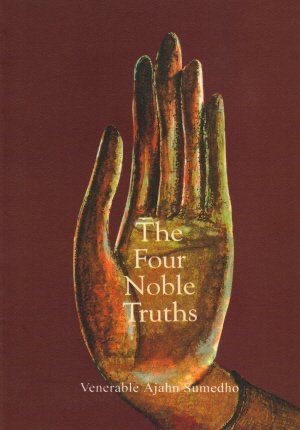
The Four Noble Truths by Venerable Ajahn Sumedho is a book I hold near and dear. After three years of its companionship, I have finally decided to write about it. Each reading, sometimes just a passage, brings a fresh insight.
Printed by The Buddhist Association of the United States (BAUS), it is a compilation of direct talks given by Ajahn Sumedho on the central teaching of the Buddha: that dissatisfaction, discontent, unhappiness, or lack of happiness can be overcome through the insights gained by reflecting on and understanding the Four Noble Truths.
The booklet is available here from the Abhayagiri Monastery. The printed copy can also be ordered via email at baus.book@gmail.com. There will be a charge for the postage.
American-born Venerable Ajahn Sumedho is a bhikkhu, a mendicant monk, of the Theravada tradition. Born Robert Jackman in Seattle in 1934, he was ordained as a novice monk in 1966 in northeast Thailand and received full ordination as a bhikkhu in 1967. He then spent a decade training under the beloved Thai forest master Ajahn Chah at Wat Nong Pah Pong, and has since been regarded as Ajahn Chah’s most influential Western disciple. He served as the founding abbot of Amaravati Buddhist Monastery in England, established in 1984, until his retirement in 2010.
What spoke to me deeply about this book and made it immensely relatable is that the book reads as if someone is talking to you directly. It is simple, straightforward and filled with everyday examples and anecdotes—experiences we all share. They are drawn from Ajahn Sumedho’s personal life and journey. It is the way he observes his own judgements, criticisms, aversions and things his mind grasps. Then the deep and persistent reflection that follows. He teaches by sharing the struggles of his own incredible path. It is very relatable and encouraging! Lay or monk, we all have the same emotions and feelings, we all suffer in one way or another. Ajahn Sumedho does not hold himself up on the pedestal as a perfect monk. He is just as human as we are. The difference lies in what we do, or do not do, about all the factors and conditions that make us suffer.
Daily life is the ground for practice. Reflect, contemplate with an open mind to see things without delusion or illusion. So the book is about direct experience and what to do about it rather than an academic, theoretical or philosophical discourse. Very practical. Repeatedly, with numerous personal stories, Ajahn Sumedho points the reader toward using the teachings as a living practice in the present moment, here and now.
Another point is that the Four Noble Truths are not presented as a belief system to be adopted. Rather, they are tools for personal investigation. Investigate, meditate, and come to your own gut knowledge/insight.
Overview
Each Noble Truth has three aspects, yielding twelve insights in total. Understanding the framework makes Ajahn Sumedho’s commentary easier to follow:
| Noble Truth | Name | Three Aspects |
|---|---|---|
| First | Dukkha — There Is Suffering | Recognize it · Understand it · Have understood it |
| Second | Samudaya — The Origin of Suffering | Craving is the origin · Let go of desire · Have let it go |
| Third | Nirodha — The Cessation of Suffering | Cessation is possible · Realize it · Have realized it |
| Fourth | Magga — The Path | Develop the Eightfold Path · It is being developed · It has been developed |
The First Noble Truth
A subtle reframing can make a big and important psychological shift. The reframing starts with the very first insight of the First Noble Truth: there is suffering. Ajahn Sumedho says: “It is phrased in a very clear way. ‘THERE IS SUFFERING’, RATHER THAN ‘I SUFFER’. Psychologically, that reflection is a much more skillful way to put it… It is not personal suffering anymore when we see it as ‘There is suffering’. It is not: ‘Oh poor me, why do I have to suffer so much? What did I do to deserve this?” So there is impersonal acknowledgement without the habitual reaction to “my” suffering. It can be a basic and important insight.
There is a direct parallel to the Satyananda Yoga Nidras as taught by my former mentor Swami Buddhananda Sarawati, formerly of the Bihar School of Yoga. (See the Yoga Nidra tracks on this website.) In the Yoga Nidras, it is “A body” and not “MY body”; “A breath” not “MY breath”; “A sensation of heat or cold” and not “MY sensation of heat or cold”. Repeatedly, the mind is pointed toward depersonalizing what arises, not identifying with it, not grabbing and grasping it, and not confusing it with “you”.
It is followed by the second insight: Suffering should be understood. Understanding means accepting and embracing rather than reacting and trying to get rid of it. Decades of meditation will confirm that one cannot “get rid” of suffering. One has to let it be. Many people come to meditation thinking that it will get rid of their problems, that life will go smoothly their way, and are disappointed.
And so we develop an understanding of suffering—the third insight of the First Noble Truth.
The Second Noble Truth
Ajahn Sumedho’s continues the reframing to the Second Noble Truth—the origin of suffering/discontent/malaise/unhappiness is desire. This insight is the same as in Yoga, Samkhya, and Jain philosophies in that desire is the cause for rebirth, the constant cycle of samsara. Desire and its resultant proliferations keep us trapped in the cycle of birth and death and suffering. Ajahn Sumedho frames the Second Noble Truth as “not about identifying with desires in any way; it is about recognising desire”. It is “A desire” as opposed to “MY desire”. The insight requires considerable reflection, investigation.
The second insight here is that desire should be let go of. He clarifies that DESIRE DOES NOT CAUSE SUFFERING. THE CAUSE OF SUFFERING IS THE GRASPING of desire. Grasping means being deluded by it, identifying with it, thinking desire is “me”, “mine”. So the letting go is listening, watching it with bare attention, not judging, not criticizing, but simply recognizing it for what it is. It is not about annihilating it, getting rid of it, which are also strong desires with desire feeding and proliferating itself. There is no battle, no conflict with desire and the wake of guilt that follows.
Allowing it to be, without any grasping of desire, it settles down. Like a glass of muddy water, with time the mud will settle down and leave the water above it clear. That is when there is the experience of peace. To me, peace is also contentment. My own personal experience is that the more contentment we experience in our meditation (which flows into daily life), the more peace there is, and there is little or no grasping. The more we let it be, the more we stop the reaction of grasping, the more contentment flowers naturally without effort. Contentment can be synonymous with peace.
Thist is not to be confused with necessities of food, water, sleep, shelter that are essential for survival. When we have eaten a simple, delicious and nourishing meal and are no longer hungry, even if there is a feast of all our favorite foods laid out before us, there is simply no desire to eat any of it. There is no desire for food. So there is no attachment to the desire for food. When the mind is at peace and content, not grasping at thoughts, it is free from the clutching suffering of desire. There is no desire and therefore no attachment to it.
Recurring thoughts, painful emotions are much more challenging than a feast of food! Ajahn Sumedho shares his own experience and frustrations of letting go. He says that when he was caught up in analyzing letting go in detail, it became very complicated and frustrating. “It was not something you could figure out in words anymore, but something you actually did really”.
One cannot grasp at peace and contentment either. It naturally follows when we stop chasing down the rabbit holes of incessant thoughts, cravings, wanting this, not wanting that.
Letting go means not grasping. But the desire is still there, perhaps in a diminished form.
The Third Noble Truth
At this point, I struggled considerably with the ending of the Second Noble Truth and the transition into the Third Noble Truth where the insight is that of cessation of craving. Whether it was due to my own misreading or the text not being as clear as it had been prior to this, it has taken persistence and a lot of inquiry to make it clearer in my own mind. There was a fog of confusion. Perhaps I was falling into the trap of being overly analytical with every sentence. Regardless, it proved to be a worthwhile effort.
Letting desire be, not grasping it, is what is called sakshi bhav in the Yoga Sutras, or non-interfering, witnessing awareness that observes with equanimity. Not feeding desire by attaching projected hypothetical narratives to it, following it, suppressing it, or identifying with it. It is an act happening within the experience of craving or desire. Objective, neutral awareness is the knowing of the presence of craving (or aversion) without adding fuel to it and proliferating it. There is no grasping of the desire which in Buddhist terms is the middle way between indulgence and suppression. So the craving can still be there and there is an awareness of it. Or as Thich Nhat Hanh would put it, the seed of craving is there but it is not being watered and cultivated.
In the Third Noble Truth of cessation, the entire structure of craving and grasping loses its grip completely. The seed itself is gone. It is the natural fruit of sustained practice and insight. It is not in a single moment of non-grasping. Cessation is not you letting go of craving but the entire push-me pull-you habitual and deeply entrenched structure actually disappearing, ceasing to exist naturally—everything that arises is of the nature to pass away.
There is no witnessing self watching. Craving arises within and is experienced by a “self”. If there is no “self”, then there is no entity to experience the arising of craving. It is the “self” that experiences the arising of craving. The mechanism or the concept of self itself has ceased. Where there is no arising there is no passing away. In non-grasping or letting be there is still subtly a a practitioner practicing. Someone is letting go. Someone is not feeding the fire of craving. In cessation that subtle sense of someone doing the practice itself is released. The fire of craving burns itself out—nothing to attain or achieve.
NON-GRASPING IS HOLDING THE FIRE WITHOUT ADDING FUEL. CESSATION IS LETTING THE FIRE BURN OUT. THE FORMER WILL LEAD TO THE LATTER.
We can practice non-grasping. But cessation is more like grace that non-grasping ripens into when the conditions are fully mature.
Ajahn Sumedho says the practice is not to attain Nibbana but to stop creating the conditions for suffering. Cessation then is not something you do. It is what remains when you finally, completely, stop doing. There is dukkha nirodha—the end of suffering.
The Fourth Noble Truth
The Buddha’s Eightfold Path is divided into three groups:
- Wisdom: right understanding, right aspiration
- Morality: right speech, right action, right livelihood
- Concentration: right effort, right mindfulness, right concentration.
These are all inextricably linked supporting each other.
The hypothesis is all clearly laid out: there is suffering (what constitutes dissatisfaction is spelled out), there is a cause for suffering (desire/craving), there is cessation to suffering, there is a path/prescription to end suffering. Test the hypothesis by following the procedure and check the conclusion.
The Four Noble Truths and Patanjali’s Yoga Sutras
There are three convergences that spring immediately to mind here and the remarkable closeness of the Buddha’s Four Noble Truths and Patanjali’s teachings in the Yoga Sutras:
Antar Mouna and Watching Thoughts Arise
Ajahn Sumedho suggests a meditation for glimpsing cessation: watch each thought from its arising to its passing, and then notice the gap — the space of no-thought at the end. This maps directly onto Swami Satyananda’s practice of Antar Mouna (inner silence), which trains the meditator to become aware of spontaneous thought, watch thoughts arise without engagement, and gradually cultivate the empty space between thoughts. The pointer is consistent across traditions: the mind habitually rushes from one arising to the next, and in that rushing never notices the natural openness already present in the gaps. Antar Mouna and Vipassana both begin with the practitioner watching — non-grasping — but as the gaps lengthen and deepen, there is a natural falling into the stillness itself. The watcher and the watched begin to dissolve into simply awareness.
Dukkha Nirodha and Chitta Vritti Nirodha
The Buddha’s dukkha nirodha — the cessation of suffering — resonates with Patanjali’s opening sutra defining Yoga: Yogas chitta vritti nirodha, the stilling of the fluctuations of consciousness. Patanjali then goes on to describe the path to achieve this. The very word nirodha — cessation, stilling, quieting — is the same in both. Both traditions point to the same recognition: that suffering and agitation arise from the mind’s reactive movement, its grasping and pushing away, and that liberation lies in the stilling of that movement rather than in acquiring anything new. The framing differs — Patanjali speaks of revealing the Purusha, pure witnessing consciousness, while the Buddha points to anatta, the absence of a fixed self — but the experience they describe is similar.
Two Eightfold Paths
Both teachers prescribe a path: the Buddha’s Noble Eightfold Path (Ariya Atthangika Magga) and Patanjali’s Ashtanga Yoga or Raja (royal) Yoga— also an eightfold path. They cover the same ground with some clear differences. The Buddha’s path is grouped into three supporting limbs: Wisdom (right understanding, right aspiration), Morality (right speech, right action, right livelihood), and Concentration (right effort, right mindfulness, right concentration). These are not sequential steps but inextricably linked supports, each reinforcing the others. In both, the domain to be “ruled” is the space of the mind, hence noble or royal.
Conclusion
The book is not about being perfect, never being unhappy, battling with our selves and the world. Our mind and our own behaviors often torment us more than the external environment. What does the external environment trigger within us? We will have happy and unhappy experiences, there will be pain and joy, grief and loss. The message is to let them be without attaching and clinging to them. They will pass—this too shall pass and cease.
The book points to a path to living more harmoniously and peacefully, with ourselves, others, and the world. Ajahn Sumedho ends by cautioning against grasping at the Four Noble Truths as well. One cannot grasp at “knowledge”, information. They point us to contemplation, see if they hold true by looking deeply at our lives and asking ourselves if this is correct.
Three years of constant companionship and counting. It takes repeated reminders and pointers, repeated reflections for the insights to reveal themselves and become gut knowing.
Perhaps this little book of profound and simple wisdom will be your companion too!


Leave a Reply